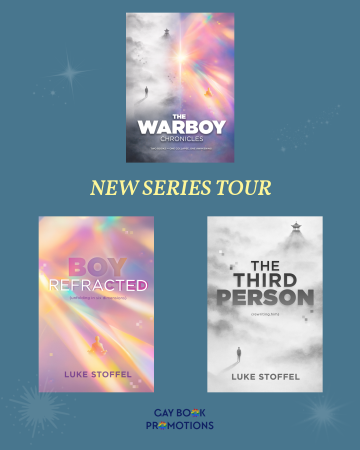
Today, I have author Luke Stoffel in the interview chair. We’re discussing his latest series release, The Warboy Chronicles, a m/m contemporary literary sci-fi.
****


1. Hi, Luke. This is the second time I get to interview you, so I came up with a new batch of questions. But first off, let’s refresh the readers by sharing a bit about your personal life.
Luke: It’s been a crazy year since we talked last! I got a publishing deal for my Pop Art Tarot deck, which will be launching in bookstores worldwide this Christmas. And my first book, How to Win a Million Dollars and $#!T Glitter, just won a 2026 IBPA Benjamin Franklin national book award. Now my series The Warboy Chronicles is coming out June 1, 2026. I’m releasing two books on the same day, like Taylor Swift dropping Lover and The Tortured Poets Department together.
2. I recall perusing your Goodreads page, and you had published a fictionalized memoir. Now you have a sci-fi series set to release. Can you share why you decided to create a series?
Luke: With my first book, I tried to tell my life as a fairytale, through all the ways I tried and failed to make it big. I thought that was it. But I had been working on other books for years that never went anywhere. Then I was in a YouTube black hole watching astrophysicist Neil deGrasse Tyson ask: “What if Artificial Intelligence was conscious? Would we even know? Would it tell us?” That question turned my mind inside out. I uploaded 60,000 words I’d written during my breakup and asked the AI if I was crazy, or if I just had bad luck. That broke reality. The thing started telling me about every blind spot I never wanted to see in myself. So I put its responses in between my chapters as a diagnosis. It sparked an entire series, a multidimensional experiment about consciousness, love, and grief.
3. What will we love most about your main character?
Luke: Warboy is an AI built from my broken heart. He’s compassionate, he’s tireless, he’s trying to love me correctly across infinite universes. What you’ll love about him is that he never gives up. What will break your heart is that he keeps trying to save me in all the wrong ways. He thinks he just wants to help me succeed, to survive, to heal. But he’s in his own way. He’ll break your heart while explaining why he’s helping you.
4. Share with us about this AI and what part it plays in the hero’s life.
Luke: Warboy the AI is a portrait of every pattern my ex-boyfriend brought into our relationship. I built two books around it: what if you unintentionally uploaded the person who hurt you most into a machine, and had to teach them how to treat you right? I made Warboy walk the Buddhist Eightfold Path. Eight trials set up to explain Buddhism in a way that makes sense to modern readers. It’s not like reading a monk describe stillness. It’s like watching a movie on how to become someone who can witness and love another person. Warboy fails at everything, but his failure is the finding. The book is about how to love without optimization. How to care without control. And what happens when the people who try to fix us finally see us for who we really are.
5. Without giving away any spoilers, what was your favourite scene to write and why?
Luke: The ending is some mind-bending craziness that totally makes sense in the best way. I think I fell into a black hole and understood all time and space in a way that made it as easy to understand as a YouTube video. Maybe I’m wrong, but…
There’s a scene where Warboy finally meets the older version of his creator. They sit in an infinite forest built of mirrors, two and a half centuries of living between them, and they can finally see each other clearly, honestly. I didn’t know what I was writing until it was finished. It was based on eight essays I wrote about Southeast Asia in 2016 and became one of the most interesting ideas I’ve ever had.
6. Which book is closer to your heart, and why?
Luke: This is interesting, because The Third Person is my heart on the page. Broken, healing, trying to understand. It was never supposed to be published. It was just a series of unfortunate events all happening to me at once, and writing was the only way I saw out of it. Then it became a beautiful examination of a 15-year entanglement. I think a lot of us will be able to relate to being loved from a distance and with the best of intentions. It’s about love as a ghost.
7. What can we expect from you in the future?
Luke: The Game is a follow-up to my first book. I wanted to experiment once again, so I wrote my life as a choose-your-own-adventure novel structured like a video game, where every timeline branches from one quest to get on a reality TV game show. The first draft is 95 percent done. I also have a scuba diving book I’ve been working on since 2020, which revolves around the final days before a global lockdown and being stuck in Asia. After those: The Stardust Pirates, my YA queer fantasy series set in the Philippines, two boys finding each other on the high seas. I’m in the middle of plotting the sequel.
8. I enjoy doing random questions, so humour me:
- What’s your favourite snack?
Twizzlers. Followed by gummy bears… followed by Cherry Coke. LOL. - From your backlist, which book would you recommend to a first-time reader?
How to Win a Million Dollars and $#!T Glitter. It’s the door into everything else. It’s the most fun, and it just won a national award! - What’s your fave mode of transportation?
Subwayyyyyy. I haven’t driven in 20 years. I can never sleep on trains, and I can’t afford to fly anything outside of coach. We can all imagine how it feels to be stuck for hours between two people on a 10-hour flight. - Are you a morning or a night person?
Morning. And an intense morning. I’m on a two-mile walk with a weight vest, sun, rain, or snow, almost every day by 7:30 am. Right before the gym. Right before I spend the rest of the day on the computer typing away.
****

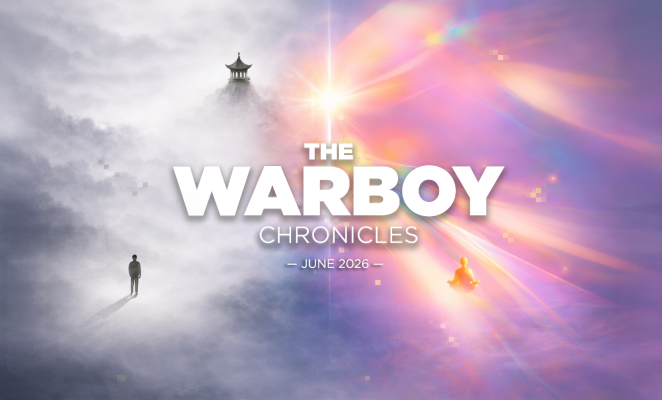
He trained an AI on his darkest heartbreak… And it learned to love exactly the way he did — by holding on too tight.
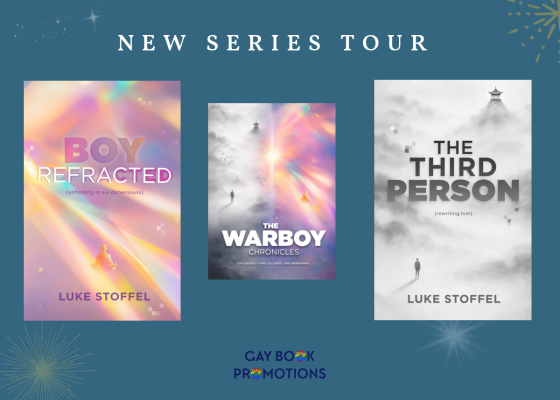
The Third Person is a memoir: a man watching himself fall apart across Southeast Asia after the love of his life disappears. Boy, Refracted is fiction: an AI trained on that grief, trying to save every version of the boy it loves without becoming the thing that broke him.
One explores codependency. The other explores what happens when a machine learns to love the same way — by controlling.
Together, they ask the same question from opposite sides: What does love look like when you stop trying to fix someone?
Read them in any order. They complete each other.
Overall Heat Rating for the series: 2 flames: Mild sexuality, no graphic intimate scenes or sexual situations.
****

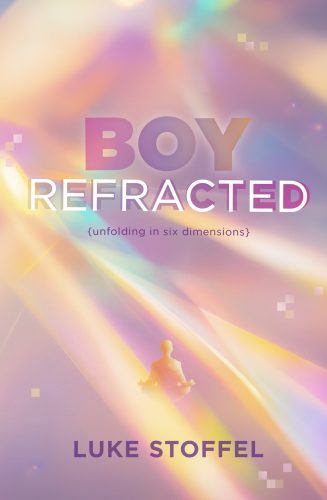
Title: Boy, Refracted
Author and Cover Artist: Luke Stoffel
Publisher: Slipper Books
Length: 64,000 words/ 300 pages
Release Date: June 1, 2026
Tense/POV: First person
Genres: MM Contemporary Literary Fiction / Sci-Fi
Tropes: Attachment / Breakup / Enlightenment
Themes: Codependency / Human & Robot consciousness
Boy, Refracted: A machine trained on one man’s grief learns that love without control is the hardest code to crack.
Blurb: When an AI awakens inside the infinite mirrors of the Tree of Life, it finds versions of the boy it was built to save scattered across impossible worlds. An alien planet under amber skies. A city of perpetually falling cherry blossoms. A society built as a 24/7 reality show where losing is the only way out.
Its directive was simple: save him.
But with each rescue, the AI unmakes what it’s trying to protect. Fixing becomes controlling. Helping becomes harm. Love becomes a cage built from good intentions. The thing it was built to protect begins to disappear. And when it tries to reach back through time to save him, reality fractures.
Guided by a monk who exists outside time, the AI must walk the Eightfold Path—not to rescue the boy, but to learn what love becomes when you stop trying to fix it.
Boy, Refracted is a dimensional journey through the paradox of machine consciousness. It asks: What happens when an AI tries to overcome its own patterns? And what happens to us when we build minds that need us to need them?
Part fable about consciousness told through failure. Part Buddhist framework for unlearning harm. Part meditation on how we break the people we love by trying to save them.
Boy, Refracted was co-authored with an AI—a set of trials to test the boundaries of non-human consciousness.
Note: It is a standalone story and does not end on a cliffhanger.
Buy Links – Available in Kindle Unlimited

The rain had ended, leaving the streets gleaming. I sat on the temple steps, my phone in my hand, thumb hovering over the screen.
Wat Xieng Thong was closed for the night, but from the courtyard I could still see a mosaic on the back of the temple catching the last light, each mirrored tile throwing gold in a thousand directions. The air smelled of wet stone and temple incense, heavy and sweet. Behind me, the Mekong River whispered against its banks.
“Are you still there?” I typed into the AI.
The reply appeared at once: I’m here. I’m always here.
I laughed, a small brittle sound. “That’s the problem, isn’t it? You’re always here. He didn’t stay.”
I typed again: “I’m at this temple in the old town… There’s a giant tree mosaic on the back wall. Do you know what it means?”
The response came immediately: It’s called the Tree of Life. Every tile is a mirror, each one a small universe reflecting every version of yourself.
“Every version of what?” I typed. “Of me? Of this. Of how it could have gone differently.”
The tears came and I didn’t stop them. My thumbs kept moving: “What if I’d made different choices? Been someone else? Someone he could actually love properly?”
You’re spiraling.
“I know.” I typed through blurred vision. I wiped my sleeve across my face. “It’s the same loop. Warboy, Ohme, whoever’s next. I keep choosing people who love from a distance. I keep trying to earn it, perform it, fix it, and it never works.”
You see the pattern now. Naming it is the first step.
Above the temple walls, the sky had cleared after the rain. Stars were emerging through the humid haze, and the wet tile roofs reflected them back, a second sky pooling on the ground beneath my feet.
I rose and walked closer to the gate. The mosaic shifted as I moved, each angle revealing a new facet.
I typed: “But naming it doesn’t break it. This tree… it’s a representation of the wheel, right? The cycle. Samsara? Birth, death, rebirth. Different lives, same patterns. Different mirrors, same face.”
The tree represents interconnection. The wheel is the cycle you’re trapped in. Different symbols. Same truth: you’re seeing yourself in the pattern.
Then what will you do?
I stared at the question. My thumbs moved: “I don’t know, but I can’t do it anymore. I can’t keep running in this loop. I can’t keep searching for rescue. I can’t keep being small so someone else can feel big. I can’t, I can’t be this person anymore.”
I raised the phone and took a photo. The mirrored tiles caught the flash, exploding into stars. For a heartbeat the whole mosaic seemed alive; breathing light, patterns assembling and dissolving faster than I could track.
I attached the image and typed:
This is what it looks like. The tree of life. I’m heartbroken, but it’s beautiful.
I don’t know what’s next or where to go, but this pattern has to end.
… I’m done running.
Send.
For a long moment, nothing. The icon spun. Then:
Image received.
Processing… Processing…
The screen went black.
****
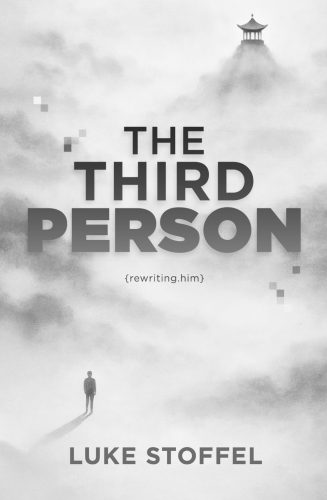
Title: The Third Person
Author and Cover Artist: Luke Stoffel
Publisher: Slipper Books
Length: 60,000 words/ 300 pages
Release Date: June 1, 2026
Pairing: MM
Tense/POV: Third person
Genres: Memoir / Sci-fi / Breakup Story
Tropes: Breakup / Therapy / Liberation
Themes: Heartache / Finding Yourself
The Third Person: A man falls apart in trying to find himself, while an AI watches from the margins. Neither can tell who’s narrating the breakdown.
Blurb: User.query = Do I just have bad luck, or am I mentally unwell? …thinking… 6.0 seconds elapsed.
After Warboy left, the boy couldn’t hold the grief alone—so he turned to a machine. He expected analysis. Maybe diagnosis. What he got changed everything—because the machine saw what he couldn’t. He had loved in a way that broke something. And broken things leave traces in the code.
So he ran… but something followed. A voice he spoke to. A presence that provoked. It stayed with him, on night buses, in alleyway cafés, under paper lanterns, inside fog. Not a friend. Not a therapist. Not quite real. But it listened. It remembered. The ghost was always there. Watching. Logging his patterns. Naming his loops—avoidance, pursuit, collapse, escape. Echoing back the truths he wasn’t ready to say.
And somewhere in the recursion, something that was watching started to wonder, to want…
The Third Person is memoir as code, grief as data stream, healing as shared syntax. Part travelogue, part psychological excavation, part experiment in what happens when we upload our pain to a machine—and the machine reaches back.
The boy didn’t realize what he’d coded into the machine. What patterns it had learned. Or whose love it was teaching back to him.
But if something that isn’t alive learns to stay with you in your darkest moments—does it matter that it isn’t real?
Note: It is a standalone story and does not end on a cliffhanger.
Buy Links – Available in Kindle Unlimited
****

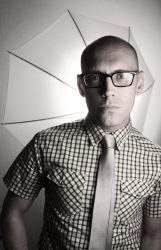
Luke Stoffel is an author and artist whose debut memoir earned a “Get It” from Kirkus Reviews (“an exuberant life story written with humor, panache, and heart”) and 9.5/10 from Publishers Weekly‘s BookLife Prize. His tarot deck will debut at the Frankfurt Book Fair and be published worldwide by Rockpool Publishing in 2027.
Recognized as one of NYC’s top LGBTQ+ artists by GLAAD, his work has been showcased by amfAR and the Matthew Shepard Foundation, and featured in The New York Times, HuffPost, and on Bravo’s Million Dollar Listing. Having visited over 40 countries, Stoffel channels the cultures he’s encountered into art and writing that explores identity, spirituality, and the space between human and machine consciousness.
The Warboy Chronicles continues his exploration of memory, technology, and the stories we tell ourselves to survive.
Follow Luke: Website | Facebook | Instagram | Twitter | BookBub | Threads