
Today, award-winning author Richard Barager is guesting. He’s talking about his latest release The Twelve Tables, a historical fiction novel. Don’t forget to enter the giveaway.
****

What’s In a Name?
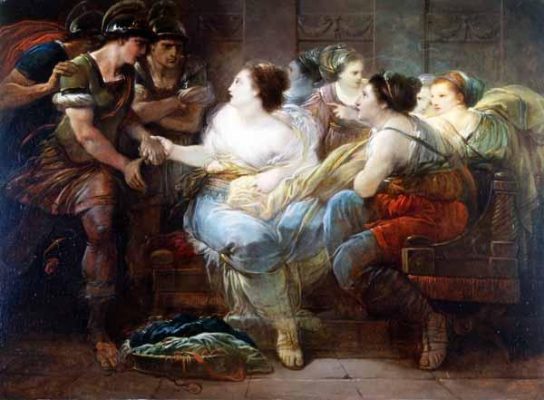
The accompanying painting depicts Lucretia holding the hand of her husband, Lucius Tarquinius Collatinus. Leering covetously at Lucretia in the background is Sextus Tarquinius, the son of Rome’s last king, Tarquin the Proud. The defilement of Lucretia by Sextus—the Rape of Lucretia—culminated in her suicide and a popular revolt that brought about the end of the Roman Monarchy and establishment of the Roman Republic in 509 BC, some 244 years after the traditional founding of Rome by Romulus, its first king. The Republic’s first pair of elected consuls were Lucretia’s widower husband Collatinus and his close friend, Lucius Junius Brutus.
Brutus’s first action as co-consul, with Collatinus’s approval, was to have all Romans swear an oath that Rome would never be ruled by a king again. But an oath was not enough to ease their fear of a tyrannical monarchy returning to power. Many became anxious that Collatinus, who bore the Tarquin name, might become a threat to their newfound liberty. “We’ve barely rid ourselves of the last Tarquin and now we have another,” people worried. “Tyranny is in their blood.” That Collatinus had become consul in a free election was all but forgotten.
Their fear spread like pestilence, as fear is wont to do. Soon all of Rome was infected by it. Brutus assembled the people and spoke to them. He began by repeating the oath against kings, the sacredness of which, he urged, must be vigilantly guarded. But to the incredulity of Collatinus, whose suffering at the hands of his kin surpassed that of any man in the assembly, Brutus warned that Romans would never feel secure in their liberty with a member of the former royal family as consul, no matter how loyal he had been to Rome. He then called on Collatinus to appease the people by abdicating his office and ridding Rome of the Tarquin name once and for all.
Collatinus at first resisted the city’s hysteria, even as other prominent nobles began to pressure him to leave—including no less a figure than Spurius Lucretius Tricipitinus, the father of his deceased wife Lucretia! Collatinus began to fear that clinging to his consulship might result in forced expulsion from Rome and confiscation of his property. In the face of even his former father-in-law’s opposition, Collatinus acceded to their demands and voluntarily exiled himself to Lavinium, retaining his possessions, if not his pride. Publius Valerius was swiftly elected by the people to serve as consul suffectus (replacement consul) alongside Brutus.
The inordinate fear of losing their liberty to the return of a king would shape the Roman Republic for centuries to come. But Collatinus’s fate also revealed a contradiction at the heart of the new Republic: Romans had expelled their kings in the name of liberty, yet liberty itself could become precarious when fear overwhelmed tradition and custom.
That contradiction still haunted Rome forty-seven years later, in 462 BC, when my historical novel The Twelve Tables begins. Rome had consuls instead of kings and assemblies instead of royal decrees, but ordinary citizens still struggled with a fundamental question: what protected their liberty when the laws of Rome remained unwritten and controlled by those with the greatest power?
Their answer would be inscribed into twelve bronze tablets and displayed for all to see. The Twelve Tables would become the cornerstone of Western legal tradition and a foundational text of Western civilization.
****

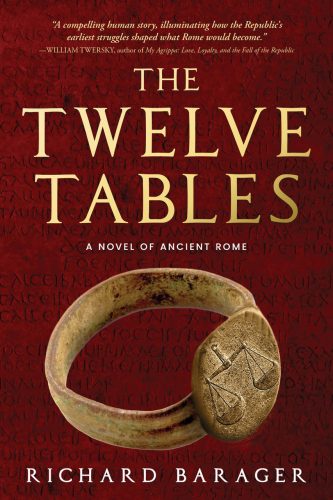
Title: The Twelve Tables
Series: N/A
Author: Richard Barager
Genre: Historical Fiction
Length: 282 pages
Release Date: November 17, 2026
“The blood of the bulls on Jupiter’s hill gave them liberty—the words graven unto these Twelve Tables made them equal.”
Blurb: ROME, 462 BC. To save his family’s failing farm, sixteen-year-old Marcus Atilius is sold into debt servitude by his own father. Plunged into the city’s underbelly, Marcus must endure a world of cutthroat trading stalls and gritty warehouses, all while navigating a forbidden entanglement with a woman far above his station. Survival demands sharp guile and moral compromise.
As a bitter class struggle pushes Rome toward the brink of civil war, Marcus vows to beat the elites at their own ruthless game to win his freedom and a fortune worthy of the woman he loves.
Yet his rise brings a fateful choice. A historic demand sweeps the city for the Twelve Tables—a revolutionary legal code to protect plebeians from patrician tyranny. With a corrupt aristocrat holding the tether to his trading empire, will Marcus protect his hard-won power, or risk everything for the soul of Rome?

Merchants, workers, and donkey-drawn carts trampled the winding streets of packed dirt. Shouting vendors sold nuts and fruit. Tinkers hammered. Donkeys brayed. Fishmongers hollered. Traders in sheds with awnings stood behind counters with meat and cheese calling out prices. Goats bleated. Cows bellowed. Sides of pork and beef hung on iron hooks, alongside bare-armed butchers in spattered tunics. Beggars and thieves lurked outside taverns, and scrawny boys emptied chamber pots into gutters. Flies buzzed, buyers haggled, and the ripe, pungent smells of manure, fish, roasted chickpeas, sweat, and animal musk clashed in the air.
It was a loud, brawling, stinking, clawing, thriving place, and Marcus had come to love it, though the thrill it gave him caused guilt over betraying the simple virtue of the Alban Hills. Many things were traded in the Boarium, but virtue was not one of them. Greed and guile and bronze were. All the same, he could not deny the jolt he got from the bustling energy and naked competition, every trade contested. A hard-eyed, lusty pursuit of wealth that not only didn’t exclude plebeians but favored them. Patricians didn’t dirty their hands in butcher stalls or slaughtering pens. They owned the law and most of the land, but in the Boarium, commoners ruled. Olives and goats and grain turned into bronze for plebs who were willing to jostle and work. Here they were less burdened by the ancient customs and traditions that priests and nobles too often turned against them. The laws of the market were clear—and applied to all. Buy or sell. Eat or be eaten. Gain or loss. These were laws Marcus understood.
****


Richard Barager is the author of The Atheist and the Parrotfish and Altamont Augie, the latter a winner of the Silver Medal in Foreword Reviews 2011 Book of the Year Awards (Historical Fiction); a Gold Medal in the 2011 eLit Book Awards (Literary Fiction); and a Silver Medal in the Independent Publisher 2012 Regional Book Awards. The Wall Street Journal reviewed Altamont Augie in its Five Best column: “No other novel so crystallizes the themes, flavors and attitudes of an era [the 1960s].” The Atheist and the Parrotfish was featured on Book Talk Radio, with Kory French.
Richard completed undergraduate studies and medical school at the University of Minnesota and was a nephrologist in private practice for many years. Long devoted to medicine and fiction, he now writes full time (and no longer at night!). He believes fiction explores meaning in ways science cannot. Sometimes only fiction can discover truth.
Follow Richard: Website | Facebook | X | Instagram
****

Enter for a chance to win a $25.00 Amazon or B&N Gift Card.
ENTER NOW!


