
I’m still on my mountaineering kick, so that means I had to read about the 1996 Everest tragedy. Today, I’m reviewing Into Thin Air by Jon Krakuker, a close look at what happened on that horrific day.


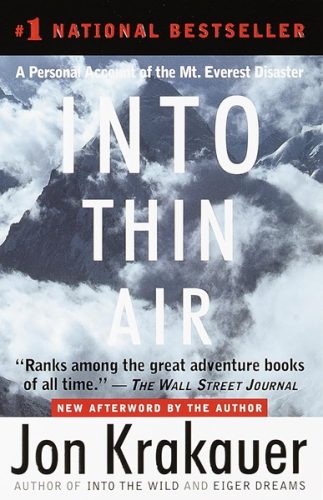
Title: Into Thin Air
Series: N/A
Author(s): Jon Krakauer (Author, Photographer), Randy Rackliff (Illustrator), Daniel Rembert (Contributor), Caroline Cunningham (Contributor), Anita Karl (Contributor)
Genre: Memoir, Autobiography, Mountaineering
Length: 332 pages
Release Date: October 19, 1999
Blurb: When Jon Krakauer reached the summit of Mt. Everest in the early afternoon of May 10, 1996, he hadn’t slept in fifty-seven hours and was reeling from the brain-altering effects of oxygen depletion. As he turned to begin his long, dangerous descent from 29,028 feet, twenty other climbers were still pushing doggedly toward the top. No one had noticed that the sky had begun to fill with clouds. Six hours later and 3,000 feet lower, in 70-knot winds and blinding snow, Krakauer collapsed in his tent, freezing, hallucinating from exhaustion and hypoxia, but safe. The following morning, he learned that six of his fellow climbers hadn’t made it back to their camp and were desperately struggling for their lives. When the storm finally passed, five of them would be dead, and the sixth so horribly frostbitten that his right hand would have to be amputated.
Into Thin Air is the definitive account of the deadliest season in the history of Everest by the acclaimed journalist and author of the bestseller Into the Wild. On assignment for Outside Magazine to report on the growing commercialization of the mountain, Krakauer, an accomplished climber, went to the Himalayas as a client of Rob Hall, the most respected high-altitude guide in the world. A rangy, thirty-five-year-old New Zealander, Hall had summited Everest four times between 1990 and 1995 and had led thirty-nine climbers to the top. Ascending the mountain in close proximity to Hall’s team was a guided expedition led by Scott Fischer, a forty-year-old American with legendary strength and drive who had climbed the peak without supplemental oxygen in 1994. But neither Hall nor Fischer survived the rogue storm that struck in May 1996.
Krakauer examines what it is about Everest that has compelled so many people — including himself — to throw caution to the wind, ignore the concerns of loved ones, and willingly subject themselves to such risk, hardship, and expense. Written with emotional clarity and supported by his unimpeachable reporting, Krakauer’s eyewitness account of what happened on the roof of the world is a singular achievement.
Available at:

Since I’m still on my “mountaineer” kick, I purchased a copy of Into Thin Air to read and review. I must say this is a powerhouse in narrative non-fiction. The author takes a tragic, complex event and turns it into a visceral, heart-pounding experience that stays with you long after the final page.
What I found engaging isn’t just the high-stakes survival story, but the writing. The author captures the thin line between human ambition and the brutal, indifferent reality of nature. Rather than just a play-by-play of a disaster, it’s a deep look at the physical and mental toll of high-altitude climbing—from the fog of hypoxia to the impossible choices made in the “Death Zone.” With your brain unable to properly assess decisions, it turns on you. How scary is that?
I also enjoyed the look into the other climbers and the many teams. The American climber Ed Viesturs is also present (with the IMAX team), since I read his book before this one. He was part of the rescue effort.
These people had to make some tough choices after the storm hit. I felt for them. There isn’t much you can do during a massive snowstorm when you’re high up. I really felt their helplessness.
The book is 800 pages on my Kobo, and I easily polished this off, unable to stop turning the page. There are introductions done by various climbers from the past to introduce each chapter, but I must admit I skimmed these since I wanted to stay in the “now” with the climbers; not be rerouted to the past.
Whether you’re a climber or a couch-bound adventurer, this is a gripping, well-paced read that offers a sobering perspective on what happens when everything goes wrong on the roof of the world. Highly recommended for anyone who appreciates top-tier storytelling.
 Maggie Blackbird