Today, I have award-winning writer Skylar Lyralen Kaye in the interview chair. We’re discussing their latest release, Bachelor X, a memoir.
****
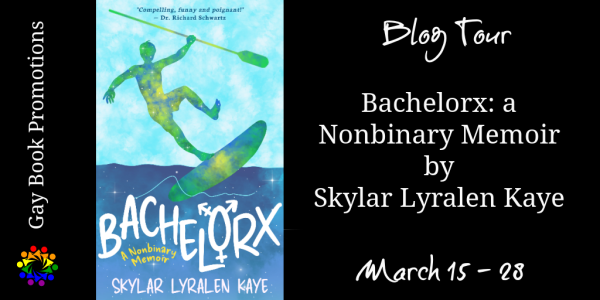

1. Hi, Skylar. First off, readers have an idea of the writer you, but what about the everyday you? Can you share about your personal life?
Skylar: My life has changed dramatically since January 19, 2025, when I left the USA. I spent January 19-November 23 on the road, traveling in Malta, Portugal, Ireland and Scotland, paddle boarding and hiking everywhere, sometimes with companions but a lot on my own. It was a breathtaking year—alone on a plastic board in a remote loch in Ireland or Scotland with clouds coming in and waves starting to build…or just slowly moving through calm waters and lily pads. Or swimming in the turquoise Mediterranean. Last year I only made 2 quick trips home to move more clothes and tech stuff over once I decided I really did want to live in Europe, at least in the short term. I settled in Portugal. I’m building a life here. I get up, meditate, make TikTok videos, sometimes do tai chi or yoga, I write, I rant on line (Substack and Facebook) and try to organize and spread information. I paddle board, I am part of the live storytelling scene in Ericeira and Lisbon; sometimes people come to visit, sometimes I hang with new people. I get a lot of time alone, which is great. It’s all very calm and unbelievably safe, especially compared to a home country now in complete disruption but always with gun violence. I’m extremely lucky that this fell into place when it did.
2. I’ve been perusing your Goodreads page and see this is your first memoir. Can you tell me why you chose to write about your life?
Skylar: When I was younger, I swore I would only write fiction. But then I wrote a personal essay about my mother because a writer friend recruited me for an anthology with queers writing about their parents. I wrote about my mother; and that essay exploded out of me. Apparently, I write creative nonfiction about the things that can’t be said any other way.
In this case, I was deeply impacted by dating relationships. Isn’t that so cliched and ironic? But I had been queer married for 35 years. My marriage was challenging and loving; we worked really hard at being intimate and sane with both successes and failures; we had fun; I was part of their family. I thought I was all mature and woke about intimacy. Hah! I had no clue about dating relationships! The things people talk about—love bombing, urge-to-merge, the call of limerence and chemistry, intensity that flashes and disappears…I had no idea! I was so innocent and so cocky! I needed to write it out to figure out what had happened. Because it turned out I didn’t know. I threw myself out there with blind confidence and got completely overwhelmed.
3. Let’s talk about the main characters: Orpheus and Eurydice. What do you love most about them?
Skylar: I LOVE myth and archetype. So the first thing I love about Orpheus and Eurydice is the idea of the archetypal artist (Orpheus) so gifted that making is easy. And when he finds his muse, it has to be tragedy—her early death forces him to go to Hades to try to save her. And he does. This is where it gets interesting. Because the way I see it, he has to give up his song to Hades to get a chance with her, and then he’s asked to give up his voice and sight on the journey back from Hades. And he can’t do it.
That’s a slight reinterpretation of the myth. As for Eurydice, she represents, of course, beauty. The ingenue. But for a me, a muse has to have a rich life in order to inspire—my Eurydice as suffered a great deal, and longs for an escape from suffering, and Orpheus tries to offer that to her. Only, his song may reveal her in ways she may not like; and she alone can escape the snake that fills her body with poison.
On the more realistic level, Orpheus is both the bard and the container for many voices that relate to and try to love each other within the context of my memoir. What I love most about Orpheus as the center of the story is their deeply spiritual connection to beauty and deepening, which is often expressed in how they love and hold presence for all their inner people. What I love about the many people inside Orpheus is how funny they are, how state-the-obvious inappropriate, how on each other’s side they always end up being. How they have their own love story with each other. And, of course, Orpheus is me.
What I love about Eurydice is the way she struggles with the hardship in her life. She is perennially hopeful and believes that this romance will be the one…that is her quest for beauty, her innocence, the way she clings to the hope of being a middle-aged ingenue. In a life of stress and struggle, she keeps believing love will come. If only she’s perfect enough. If only the other person is perfect enough. And she has this incredibly deep need for care and safety that drives every encounter, even while she caretakes. She tries hard to be a good person, and she looks for and makes a lot of rules, hoping the rules will save her and everyone around her. I have a lot of compassion for her complications.
I also really love the way Eury and Orpheus mirror each other’s childhoods. The way they mirror each other.
4. And what makes you shake your head at them?
Skylar: For the many parts of Orpheus, their willfulness and insistence on their own way gets them into trouble A LOT. Kaye, the inner wise yoga teacher, is always giving advice that is 100% accurate, but the other needs overwhelm her wisdom. And Orpheus the center–one of the inner Orpheus characters, Kara, says, “Orpheus just sits and there and don’t do nothing.” So the essential nature of being that Orpheus embodies can be frustrating, because it truly is yin. It’s being, not doing.
I shake my head at Eurydice’s deep insecurity, her struggles in her relationship with her body, her endless busyness and trying to get right what doesn’t need to be right, her ideas of safety that cause her to attempt to shape the world to make her feel better. Which of course can’t be done. The irony of her self-caused Sisyphean struggle.
5. Without giving away any spoilers, what was your favourite scene to write and why?
Skylar: I loved writing so many scenes! But I especially did like writing the end, both the last two chapters and the epilogue, because redemption is beautiful. Equally, five-year-old Kara going off on a rant about frogs and puppies was incredibly fun. She is a character who always makes me laugh.
6. Share with us a couple of things about Tobi, the ex who gets left behind.
Skylar: Tobi, trans masc, asexual, has their own journey. At first, they just want to hold onto Orpheus; and as they’ve kept secrets in the marriage that Orpheus learns when they leave, the beginning is far from pretty. But it’s very sweet how much Tobi loves Orpheus, and how that love is fully returned. Tobi is deeply flawed, but so redeemed by the end. And Tobi is a curmudgeon, very much themself, irritating and deeply lovable. I also love writing the banter between Tobi and Orpheus’ inner kids.
7. What about your title. Love it. How did you come up with it?
Skylar: I really struggled with the title! I wanted something that would hint at the way I was using the Orpheus myth and the expression of plural identity. I tried things like A Nonbinary Orpheus…but I just couldn’t find anything that wasn’t already in use—there are a ton of books with Orpheus in the title. And then I was on the phone with one of my closest friends—who is in the book and is also an artist—and we were batting around ideas. She LOVES The Bachelor and I said, “Oh, my God, what about Bachelorx?” And we howled laughing because we both immediately knew that was right, that was the comic heart of the story.
8. What can we expect from you in the future?
Skylar: I wish I knew what to expect from me in the future! This book is the third project in which I come out as plural, and that’s a lot of freedom and resistance at the same time. What I know for sure: you can expect me to be found on any body of water in any season paddling and talking to the fish and birds. You can find me leaning toward performing some version of this book. Doing yoga. Also telling stories in general while working for freedom and justice.
9. I enjoy doing random questions, so humour me:
• What’s your favourite movie?
From childhood, The Sound of Music. Adult it’s actually tv: Six Feet Under. Movies…so many indies! Anything with Judi Dench. Love Nicole Holofcener, especially Please Give.
• What book is currently in your e-reader?
The Italian Adventure by Gaia Amman, a nonbinary novel
• Who’s your favourite musical group?
I’m very into Lady Gaga. I also love Billie Eilish.
• What song puts a smile on your face?
Shivers by Ed Sheeran, partly because there are two women who dance the bachata to it and they make the song so sexy and magical. Magda and Valeria—from Spain, I believe.
10. Is there anything else you’d like to add?
Sklyar: I love theater—Hadestown, the Syringa Tree, Faith Healer, A Strange Loop, Fun Home. Those 5 alone make life worth living!!!! I’ve seen Hadestown three times, Fun Home three times, A Strange Loop twice, the Syringa Tree twice. Theater is church in what that word should mean.
And if you want something really random, check this out: https://themoth.org/stories/my-mother-the-nun-and-me
****

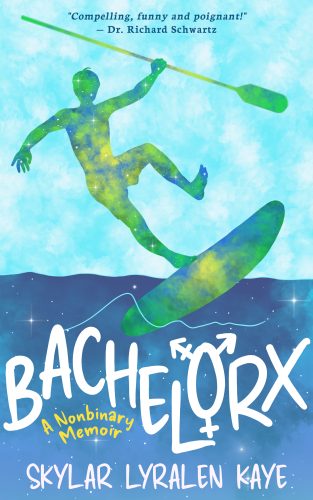
Title: Bachelorx: a Nonbinary Memoir
Series: N/A
Author and Publisher: Skylar Lyralen Kaye
Genres: Literary memoir with graphic and autofiction elements
Pairing: Nonbinary protagonist/lesbian and trans love interests
Tense/POV: present tense/alternating POV.
Tropes: Friends to lovers
Themes: Coming out, Dating and sex, search for love, queer divorce, neurodiversity
Heat Rating: 3 flames
Length: 319 pages
Release Date: April 1, 2026
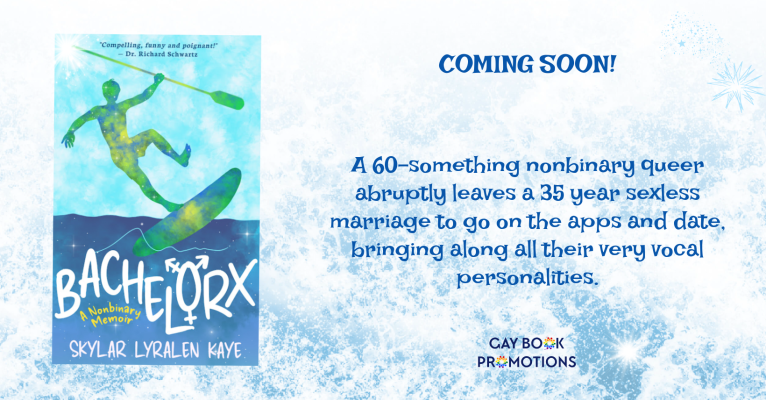
A 60-something nonbinary queer abruptly leaves a 35 year sexless marriage to go on the apps and date, bringing along all their very vocal personalities.
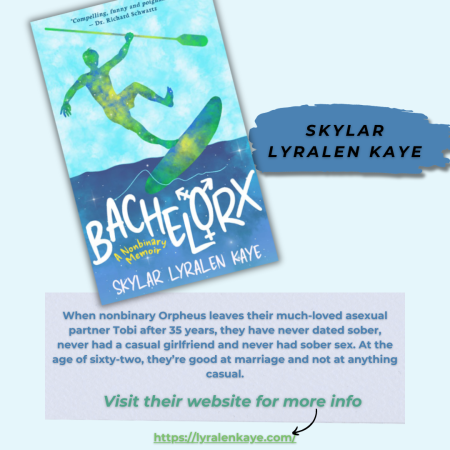
Blurb: When nonbinary Orpheus leaves their much-loved asexual partner Tobi after 35 years, they have never dated sober, never had a casual girlfriend and never had sober sex. At the age of sixty-two, they’re good at marriage and not at anything casual.
They’ve been living out and proud not only as nonbinary, but also as plural, filming a queer web series.
They’re completely unprepared for middle aged lesbians and their complicated desires. Romance, flirting, love-bombing, control, seduction, desire roll into Orpheus’ life and wake up every possible opinion among their many vocal and vulnerable personalities.
Their very painful history gets woken up in all their inner people, too.
As teenager personalities revel in the “queer prom that never was,” as Orpheus experiences a first kiss with a much younger trans person and then goes on to make out with a woman who confesses trauma in between flicks of her tongue, as child personalities run for cover and the wise inner yoga teacher Kaye warns that none of them are ready to date, Orpheus dog paddles through the waves of dysfunctional urge-to-merge dating.
Then two friends die and their landlord sells their building. Their now ex Tobi totals their car and breaks their own back.
Will a Eurydice appear, Orpheus wonders, as they search the apps.
Then she does, with a lump in her breast, heart problems, a live-in mother, disabled son and a need for a partner who will hold on, listen and take care of her no matter what comes, as they touch in a rush of a second adolescent joy.
At week six, Eurydice’s at passion. At week seven, she’s talking about adding an addition to her house.
And Orpheus, who will say that they’re plural but won’t show it, who resists commitment only in their silences, goes to every medical appointment, every work occasion, every family party, as their personalities argue about whether to stay, whether to go, whether anything could possibly be right with this woman they can’t get enough of touching.
Every hero must journey to Hades. In the story of Orpheus and Eurydice, innocence is sacrificed to experience. Life walks in when you open the door. No matter your age or circumstances.
Style: Worth noting that Bachelorx contains both graphic elements and fictional/mythopoetic elements. It’s intentionally outside the box, aiming for a true representation of neurodiversity while including comedy.
Note: It is a standalone book.
Buy Links – Pre-Order Now

The child Orpheus comes forward in a memory of sunlight. Walking the long line of the green painted two by fours that top posts connecting a chain link fence, they follow its border behind the suburban homes of their Ohio neighborhood. They balance easily, their 1960’s striped t-shirt warmed by the light. Around them insects and birds raise voices for them to listen. They never fall. Held to the earth by tentacles of energy they send to every living being, they ask Gaia to become one with all life, just for a while, just until the pain eases and they can rise alone into a liminal sky, turning poems into songs.
Not boy, not girl, not feminine, not masculine, not straight, not cisgender, not singular, not a member of any tribe that will lay claim to them, Orpheus learns early to become everything.
* * *
That pandemic spring, I slump over my computer late into the evening with colleagues in California, figuring out how to get actors to film themselves while crew observes on Zoom. Outside the window, the moon hovers over treetops and telephone poles. At the far end of the street the commuter rails screeches by, empty of people. Staring forward into the computer screen, I compare lighting between sets in San Francisco and Pottstown, Pennsylvania. My director of photography assesses eyelines as I give notes to actors before calling for one last take to wrap the day. A multicolored collage of queer bodies appears on the screen as close Zoom. Androgynous nonbinary bodies like mine, trans masc like my spouse, cisgender women, old, young, BIPOC, full-bodied, thin, allo and asexual, appear with a background of pink, people like the ones I interviewed and whose stories I tell.
I stagger into the bedroom. Pull off my jeans and fall onto the bed in boxer shorts. My spouse Tobi stands near the entrance to the kitchen, tapping a foot on the floor, a stained green button down over their full belly. They stare, deep-set brown eyes burning toward me, toes pointed out, just a little bowlegged.
“Five minutes, Orpheus,” they say. “You could at least give me five minutes.”
“I have to sleep.”
“Then in the morning.”
“I have to work. You know I have to work.”
“Get up five minutes early.”
“I can’t. I’m too tired.”
They stomp into the kitchen, bang some cabinets. I cover my head with a pillow.
The next day, Tobi, now wearing a stained brown shirt—their ability to spill food on themself still confounds me after three decades—turns on the Biden-Trump debate at full volume. Stomping over the hardwood floors into the bedroom, I grab the clicker from where it lies on the bed.
“Everyone on Zoom can hear you.” I turn the television off.
They grab the clicker and turn it back on.
I turn it off.
They turn it on.
I turn it off.
“Watch on your computer or somewhere else,” I tell them. “I am WORKING!”
Abandonment issues meet workaholic artist.
Two days later, Tobi leaves to stay in an Airbnb so I can work in peace. Sleep in peace. Not be triggered.
They stay away for a month.
When they come home, I bring up polyamory.
****

Skylar Lyralen Kaye, fae/they is a queer, neurodivergent, social justice and award-winning writer as well as a lifelong activist. They have a BA in English from the University of Arizona and an MFA in Theater fromSarah Lawrence College.
Kaye was nominated for a Pushcart Prize in Fiction in 1997 and was a finalist for the 2005 Massachusetts Cultural Council of thebArts Awards in Playwriting. They have published in literary journals such as Calyx, Persona, Phoebe, Girlfriends, Happy Magazine and the
anthology Out of the Ordinary, Children of LGT Parents as well having published the novella Priest Kid and most recently the novel Leaving Winter for a Desert Sky. Skye has had multiple theatrical productions of their plays as well as performing as a solo artist and running the theater company Another Country Productions. Their most recent awards include the 2021 NE Film Star Award as well as 13 film festival awards for the web series Assigned Female at Birth. In 2018 they won Best in Fringe at the San Francisco Fringe for the one person show My Preferred Pronoun Is We, in 2017 the Moth Story Slam and in 2018 the Boston Story Slam. Some other awards include: the 2015 Meryl Streep Writers Lab for Screenwriters and the 2002
Stanley and Eleanor Lipkin Prize in Playwriting.
Follow Skylar: Website/ Newsletter Sign-up | Facebook | Bluesky | Instagram | Pinterest | TikTok | Substack

 Maggie Blackbird