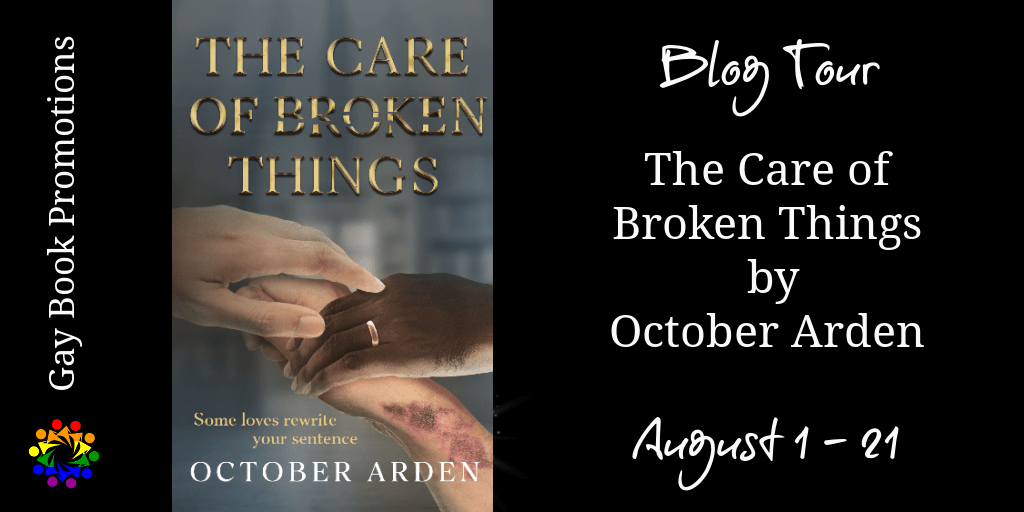
Today, I have author October Arden in the interview chair. We’re discussing her latest release The Care of Broken Things, a m/m/m contemporary prison romance. Don’t forget to enter the Rafflecopter giveaway.
****

1. Hi, October. First off, readers have an idea of the writer you, but what about the everyday you? Can you share about your personal life?
October: The everyday me. Well, I’m a creature of routine, but mainly out of necessity. My chronic illness (Mast Cell Activation Syndrome) dictates much of my life: rigid schedules, limited energy, and a carefully controlled environment where “fresh air” is actually a forbidden phrase. I tend to follow the schedule of the average three-year-old, heading to bed before the sun sets in summer because I need to reserve most of my mental bandwidth for writing.
As for personality, I’m an introvert who has basically ascended to “hermit” status, so my hobbies are quiet ones—reading, knitting, journaling with obnoxiously bright fountain pen inks (Japanese inks reign supreme, and I will die on this hill), and a neurodivergent obsession with trains. My brain’s daily energy goes mostly to writing, so other pursuits have fallen by the wayside. Sorry, Japanese language—you’ll have to settle for a mix of random nouns and profanity applied to everything.
2. I’ve been perusing your Goodreads page, and see you enjoy writing about “characters who are chronically ill, neurodivergent, or quietly self-destructive.” Can you share why?
October: The simple answer? I write what I know. I’ve been chronically ill most of my life, with my MCAS taking a significant downturn in my early twenties and progressing continuously since then. My neurodivergence (ADHD) went undiagnosed for years because I masked it with overachievement and self-punishment—a reality that proved alienating and worsened that destructive voice in my head.
I find there’s a quiet self-destruction in trying to force yourself into a mold that doesn’t fit, something many marginalized people understand. Whenever there’s a “normal,” there’s automatically an “abnormal.” My characters grapple with that tension: the shame of being “broken,” the exhaustion of performing “normalcy,” and the radical act of learning to exist as they are. Either you learn to accept your differences, or you quietly destroy yourself trying to become something you aren’t.
3. Your latest release is The Care of Broken Things. Can you tell me what inspired you to write about an imprisoned character?
October: While I’ve never been incarcerated (and I’d better hope I never am—it would probably take all of one meal in prison to send my invalid ass to the afterlife), I understand feeling trapped. My illness effectively locks me indoors for months at a time. Between April and September, I’m especially vulnerable—pollen, heat, even cooking smells can trigger life-threatening reactions. My windows are sealed year-round, and everything entering my apartment must be inspected and cleaned.
Samuel’s chronic “fight or flight” mode mirrors my own: the body as both prison and betrayer. When my body sees almost everything as a threat, it’s easy to relate to his hypervigilance. His story isn’t about sensationalized prison violence but about survival, shame, and the fragile hope of connection when the world treats you as dangerous.
4. Can you share your writing process for the novel? Did the plot come first or the characters, etc.?
October: The characters came first—and these are extraordinarily special to me. Samuel and Nathaniel were my very first original characters, years before I moved beyond fanfiction and stick figure comics about my own life. Eli joined the dynamic later, but he’s inseparable from them now. When I think of Nathaniel and Samuel, I think of Eli. All three are impossible to separate in my mind.
They’ve lived in my head so long they feel real, and I often find myself imagining them in other scenarios much more than I do with other characters. The plot grew from their dynamics: how love functions when everyone is carrying fractures. (On that note, I can safely say I have at least one AU spinoff planned for these three.)
5. Let’s talk about the main characters. What do you love most about Samuel, Eli, and Nathaniel, and what makes you want to shake them?
October: Eli is who I wish I could be: strength and kindness personified. He carries the brunt of the chronic illness in this story and seems to bear it with more grace than I do, though we both tend to “mask” symptoms from loved ones. He isn’t all sunshine though. He has darkness in him, and isn’t above manipulating people if he thinks it’s for their own good. There’s also toxic masculinity in his “no one must ever see me weak” attitude. But he’s genuinely good with a very large heart.
Nathaniel embodies something I learned a word for because of him: “compersion”—celebrating others’ joy rather than feeling possessive or envious. This man has ungodly levels of trust and acceptance. He loves so cleanly, almost as if he can pull himself out of consideration when prioritizing the people he loves. He specializes in sacrifice but in a way that doesn’t make him a martyr. I’m kind of in awe of him, though I do wish he’d consider his own needs more often.
Samuel is a walking wound. He’d do anything for the people he cares for and nothing for himself. I hope dearly he can come to value himself, but for now I’ll settle for him finding value through loving and serving others. This man is my precious son, and after giving him such a tragic backstory, I am physically incapable of inflicting any more harm on him.
6. Without giving away any spoilers, what was your favourite scene to write?
October: Samuel and Hailey’s interactions—there’s something so healing about their bond to me. I wish I could have included more of them in this particular book. I also love any scenes where Samuel is being a mother hen without realizing he’s being a mother hen.
7. If a reader asked you why they should read The Care of Broken Things, what would you tell them?
October: I’d tell them the book is for anyone who’s felt “too broken” to connect, or felt it was “too late” to heal. Though everyone is burdened with brokenness and expects tragedy in their lives, I don’t think people spend enough time considering how those tragedies impact the way we see and interact with the world. The more we hurt, the more we can close off to protect ourselves, but I think healing only really begins with openness.
This book argues that we can love because of our brokenness, not despite it. Shame is one of the most powerful feelings in the world, and it steals so much from us. I’m a big proponent of readers overcoming shame through radical self-love. It can be a difficult read at times—check the content warnings—but if you’ve ever needed to feel seen in your struggles, this book is especially for you.
8. I enjoy doing random questions, so humour me:
• What’s your favourite movie?
Tokyo Godfathers—I love everything about it. The queerness, the found family, the absurdity clashing with tragedy, the broken characters doing their best. Everything is done beautifully.
• What book is currently in your e-reader?
Nora Sakavic’s most recent releases in her Foxhole Court universe. I read the original trilogy over a decade ago and was recently prompted to revisit the world.
• Who’s your favourite musical group?
I joke with my family that my favorite single ever released is “rain on a tin roof.” When sensory overload takes over, music becomes noise to me, so I need something soothing like nature. On the hard days, drowning myself in water sounds is the best thing I can do.
• What song puts a smile on your face?
This is going to date me, but Train’s “Drops of Jupiter” always makes me smile when I hear those initial chords.
9. Is there anything else you’d like to add?
October: A content note: Sexual assault, including past childhood sexual assault, is a theme in this book. I wrestled with portraying it responsibly, especially given media stereotypes about prison violence. While official reports put sexual assault in male prisons at about 4%, that figure is generally considered vastly under-reported due to fear, stigma, and lack of trust in the system—real numbers could easily be over 20%.
I admit my own experiences with CSA strongly influenced my choices in this book, and the shame Samuel feels largely mirrors my own struggle. I know some readers will set aside this book when they see the content warnings, and that’s fair. This book isn’t for everyone. But I believe readers can find value in it, especially those who might feel seen and spoken to after reading. This book isn’t gratuitous—it’s for those who’ve felt shame and needed to hear: You’re not ruined. You’re loved.

****


Title: The Care of Broken Things
Author and Publisher: October Arden
Tense/POV: Third person, past tense, single POV
Genres: Contemporary MMM prison romance (leans into literary with a strong romantic core)
Tropes: Grumpy/sunshine, found family, hurt/comfort, healing from grief, obsessive devotion, fake dating, prison husband, marriage of convenience, wrongfully imprisoned, morally gray characters, polyamory that heals
Themes: Trauma recovery, self-loathing to self-worth, redemption through love, the violence of tenderness
Heat Rating: 2 out of 5
Length: 82,000 words/320 pages
Release Date: August 1, 2025
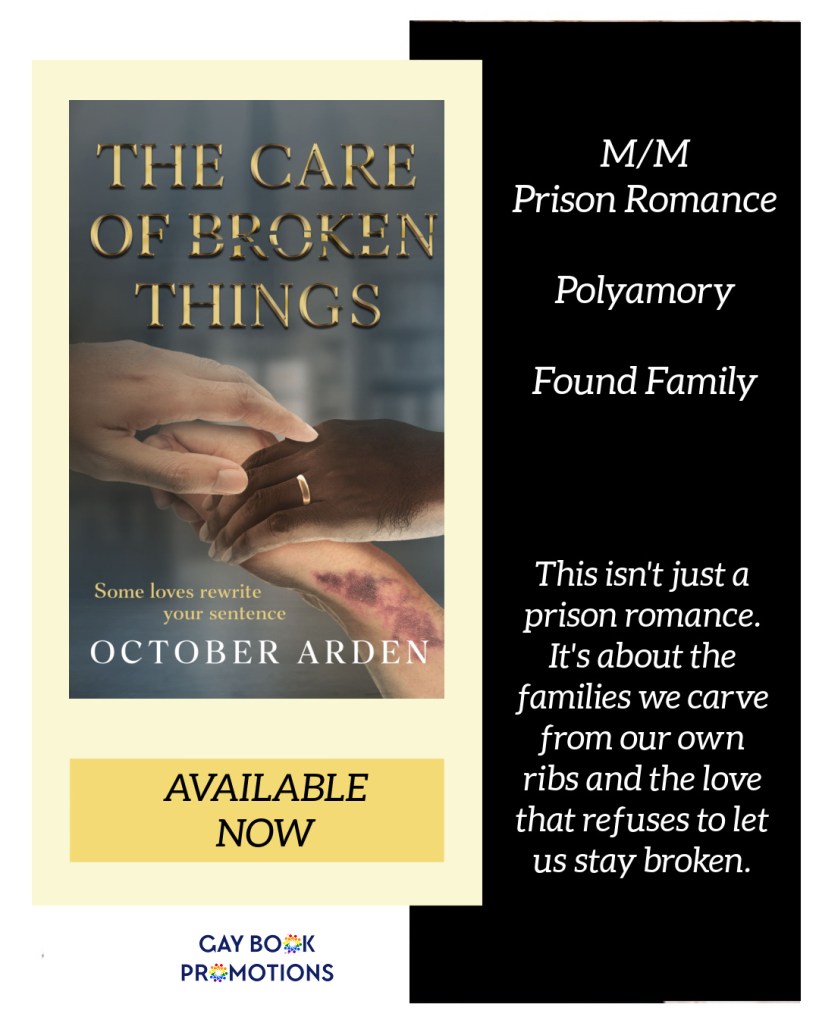
Blurb: Samuel has spent years building walls.
Not the prison’s concrete ones, but the kind that keep lives from bleeding into each other. As the prison’s self-appointed librarian, he’s carved out a fragile peace where silence is his shield. The inmates call him The Ice Queen—a title he wears like armor. After a lifetime of being preyed upon, he knows better than to let anyone close.
Then Eli arrives like sunlight through bulletproof glass.
A wrongfully convicted pediatrician, and unbearably kind, Eli is everything Samuel knows to avoid, so when he steps in to protect the man, it’s supposed to be a one-time act of mercy.
But Eli’s husband has another plan.
Nathaniel—who looks at Samuel like he’s something more than a convict—makes a request that shatters everything:
“Be his prison husband. Love him where I can’t.”
It’s a lie that should be easy. Samuel’s an expert at deception. But the longer he plays the role, the more the lines blur: Eli’s warmth seeping into his frozen bones, Nathaniel’s quiet strength, the whispered secrets of Eli’s daughter who trusts only him.
Now the man who built his life on solitude hoards these moments like contraband.
Some loves rewrite your sentence.
A devastating queer romance about the families we carve from our own ribs, and the love that refuses to let us stay broken.
Note: It is a standalone book and does not end on a cliffhanger.
Buy Links – Available in Kindle Unlimited

Twenty minutes later he kicked Eli’s bed. It had been a day and a half since the library incident, and he hadn’t spoken a word to him since. He’d thought Eli’s perseverance would continue, but maybe the man was learning about personal space. He knew he ought to be happy about that, but the change unnerved him. He didn’t like things that didn’t come with explanations.
Eli didn’t open his eyes. “Hi, Samuel.”
“How’d you know it was me?”
“Your particular brand of hospitality.” The man paused. “Also, you smell like Reese’s cups.”
“You can smell that from here?”
He took a somewhat discreet sniff of himself, but all he could detect was the shitty prison detergent.
“Hunger sharpens the sense.”
He was appalled. “You still haven’t—It’s been 48 hours!”
“I’ve done 100 hour fasts before.”
That boggled the mind. “Why?”
“To rest my gut after glutenings, mostly,” Eli said. “Why is it that you can ask questions of me, but won’t answer any of mine?”
True to form, he ignored the question and upended his new purchases onto the bed. Eli’s eyes sprang open. “What—”
“No more fasting.”
Eli picked up one of the packages on his chest. Sardines.
“They’ve got Omega 3’s, right? That’s good for inflammation. There’s some salmon there, too, in those pouches.”
Eli sat up. Packages and pouches slithered off him and onto the bedspread.
Suddenly nervous, Samuel found himself rambling. “I wasn’t sure if your commissary account was up and running yet, and the stuff I gave you before were things you couldn’t eat, so I—”
The man was smiling. Not smirking, not grinning—and Samuel knew he was in trouble.
“You’re amazing,” Eli said, as if he hadn’t just ruined a man’s life. “Thank you. And you’re right. My commissary account still isn’t linked up yet.”
As if that wasn’t enough, Eli then swept a space clear on the bed and pointed his invitation. It was the smile Samuel would blame later. He sat where indicated, more pliant and cooperative than he’d ever been in his life.
Eli was impressed. “This is a better haul than I was expecting. I might actually survive on this.”
Samuel was beginning to come back to himself. It was easier now that Eli was sorting through the food, like the spell of that smile had been broken—or at least weakened.
“Who’s Nathaniel?”
Eli flashed him a grin. “My murderer-hating husband.” He ripped open a bag of trail mix. “Don’t suppose I could trouble you to eat the M&M’s out of these for me?”
He expected the man to dig in, but Eli only ate an almond, a cashew, and a peanut before setting the package down. That broke his brain a little. “Aren’t you hungry?”
Eli brought the pouch of sardines up to his mouth and ripped it open with his teeth. “Labels are useful, but they’re not foolproof. If I haven’t reacted in half an hour, I’ll eat a little more.”
Samuel knew that if he’d gone more than two days without food, he’d have gnawed his own leg off. “Why didn’t you come to me?”
“Hmm?”
“You knew you couldn’t eat what I bought you, and you knew they’d continue to keep screwing up the special meal thing. So why didn’t you come to me? We could have done this two days ago.”
Eli fished a sardine out with his fingers. The slimy things looked repulsive, and the smell alone was enough to knock someone out. Eli caught him staring and tilted the pouch toward him. “Pardon my rudeness. Would you like some?”
He had to swallow bile. “Your husband’s never going to kiss you again.”
****


October Arden writes emotionally raw queer stories that live somewhere between literary fiction and romance. Their work explores fluid identities, found families, co-dependent devotion, and complicated love—often through the lens of characters who are chronically ill, neurodivergent, or quietly self-destructive. These are stories for anyone who’s ever felt unwanted or unseen, where even the most damaged hearts can find a home.
October loves hearing from readers, so feel free to reach out, ask questions, or suggest what you’d like to see next. You can also join the newsletter to stay in touch—and as a thank you, you’ll receive a free copy of Starting with Cake, a quietly unhinged neurodivergent love story full of snack cakes, janitor uniforms, and the kind of care that sneaks up on you.
Follow October: Blog/Website | Facebook | Instagram | Newsletter Sign-up | TikTok
****

Enter for a chance to win your choice of ebook from the author’s backlist.

 Maggie Blackbird