
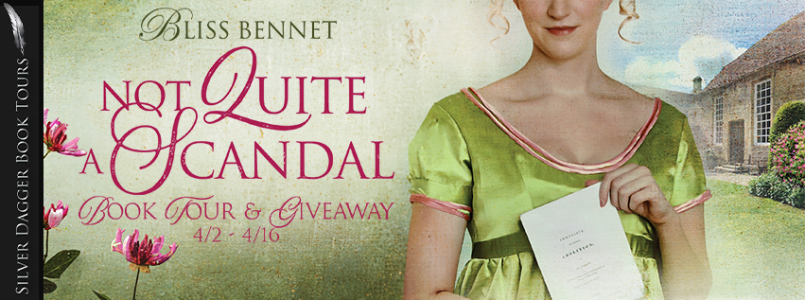
Today, author Bliss Bennet is guesting. She’s talking about her latest release Not Quite a Scandal, book two in the Audacious Ladies of Audley series, a Regency historical romance. Don’t forget to enter the Rafflecopter giveaway.
****

“Slave holding, it turns out, could not be abandoned so easily”: How renowned British abolitionist William Wilberforce almost allowed his daughter to marry a man whose wealth was built on slavery.

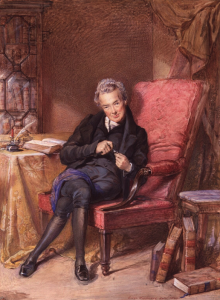
In an age and country fertile in great and good men, he was among the foremost of those who fixed the character of their times; because to high and various talents, to warm benevolence, and to universal candour, he added the abiding eloquence of a Christian life. Eminent as he was in every department of public labour, and a leader in every work of charity, whether to relieve the temporal or the spiritual wants of his fellow-men, his name will ever be specially identified with those exertions which, by the blessing of God, removed from England the guilt of the African slave trade, and prepared the way for the abolition of slavery in every colony of the empire. —Statue of British abolitionist William Wilberforce in Westminster Abbey
It can often be a challenge to include a real historical figure in a work of fiction, especially when that person played, and continues to play, an iconic role in a country’s sense of itself. Take, for example, William Wilberforce, whom many people will likely name if asked who was most responsible for bringing British slavery to an end. Wilberforce holds an almost sacred place in English history, a national icon symbolizing Britain’s moral righteousness as the first European country to first outlaw the slave trade, and then to outlaw slavery itself. But Wilberforce was a far more nuanced character than his saintly reputation suggests, nuances that I tried to capture in his cameo appearances in Not Quite a Scandal.
Biography has often slipped into hagiography when it comes to Wilberforce, a trend that began with the publication of the five-volume The Life of William Wilberforce by his sons Robert and Samuel in 1838. Unlike Thomas Clarkson’s 1808 History of the Rise, Progress, and Accomplishment of the Abolition of the African Slave Trade, which suggested that the “glories” of the abolition movement “were divisible among many,” the Wilberforce brothers’ account of their father’s life conveyed a “simplistic myth of Wilberforce and his evangelical warriors in a holy crusade” (Wilson, 160; Spiers, 48). The biography’s popularity, and its use as a primary source for later historians, has meant that for nearly 150 years, the public imagination has regarded the silver-tongued Parliamentarian as the dominant, as well as the most righteous, actor in the anti-slavery movement. Although more recent biographers and historians have begun to debunk that myth, Wilberforce’s saintly reputation continues to this day, as the laudatory but historically inaccurate 2006 film Amazing Grace amply demonstrates (see this review for details).

It doesn’t take much digging to find the more nuanced man behind the holy icon. For one, we can look to the name of new organization he and other abolitionists founded in 1823, when they realized that outlawing the slave trade would not, as they had hoped, also bring an end to slavery itself. “The Society for the Mitigation and Gradual Abolition of Slavery throughout the British Dominions” suggests not only its members’ commitment to abolition, but also the tentative nature of their calls for emancipation. “Mitigation” of slavery, or, in other words, the initial championing of laws to make slaveowners treat the people they purportedly owned less harshly than they had heretofore been allowed to; “Abolition” of the evil institution, but only at a “Gradual” pace, a pace that would not prove too threatening to Britain’s politically powerful West Indian plantation owners. Today, many would likely view such a tentative approach to the abolition of slavery as craven, even racist. How could any right-thinking person not insist that the evil institution be declared illegal immediately? But in the 1820s, most British abolitionists urged a gradualist, not an immediatist, approach.
Why? In part out of fear of the negative impact immediate emancipation might have on Britain’s economy. And in part because of the powerful influence of colonial interests, in both British politics and society. Alexandra Franklin has identified eighty-six men who not only served in the British House of Commons, but also owned colonial slave plantations between the years 1790 and 1820. In fact, it was difficult to move at all in genteel British society without interacting with those who supported themselves on the forced, uncompensated labor of enslaved Africans.
Even Evangelical William Wilberforce could not insulate himself completely from such social—and even closer—interactions. The almost-engagement of his daughter Elizabeth to Bristol banker Charles Pinney, depicted in Chapter 19 of Not Quite a Scandal, actually happened (although in 1825, rather than 1824, as it does in my book). In 1762, Charles Pinney’s father inherited several slave plantations in the colony of Nevis; while he sold them in 1808, well before his son proposed to Elizabeth Wilberforce, much of that son’s own wealth stemmed from the mortgages his bank held on other Caribbean plantations. If such mortgages went into default, not an uncommon occurrence, the bank became the owner of the foreclosed estates, including the people enslaved on them. As Anne Stott, who recounts this surprising incident in Wilberforce: Family and Friends, notes, “slave holding, it turns out, could not be abandoned so easily” (234). Wilberforce, taken by Pinney’s overt piety and wishing Elizabeth happily settled, disregarded the potential bad press the marriage of the great William Wilberforce’s daughter to a man with West Indian connections would inevitably bring. Only after being severely chastised by old friends and fellow abolitionists did Wilberforce finally write to Charles Pinney expressing reservations about the connection. While Wilberforce said he would not use his parental authority to influence Elizabeth’s decision, Pinney clearly saw the writing on the wall, and broke off the tentative engagement soon after.

Though it may shock us that the leading abolitionist of his day would not immediately dismiss a man whose family wealth, and whose own income, derived largely from slaveowning, historians would likely not be quite so surprised. A minority, but a significant minority, of genteel British men and women during the Regency period owed their incomes to the colonial slave trade, and even the most zealous of abolitionists often found it impossible to avoid socializing with those with West Indian connections. Especially if one’s relations married those with such connections, as did Wilberforce’s cousin, Bessie Smith.
It can be disillusioning to discover that a person we wish to hold up as a moral exemplar has feet of weak, breakable clay. But I think it’s far more interesting—and far more emotionally healthy—to be able to recognize the imperfections in the people we hold up as heroes than to view them as saints without flaws. Because one needn’t be a saint to inspire others to change the world—one of the lessons the protagonists of Not Quite a Marriage learn by story’s end.
With a little help from the complex, contradictory, and often disappointing human being behind the saintly image known as William Wilberforce.
If you want to find out more about the fascinatingly complex William Wilberforce, check out these books and online sources:
Amazing Grace review. 1807 Commemorated: The Abolition of the Slave Trade. Institute for the Public Understanding of the Past and the Institute of Historical Research. 2007.
Bradley, Ian. “Wilberforce the Saint.” In Jack Hayward (ed.) Out of Slavery: Abolition and After F. Cass, 1985.
Clarkson, Thomas. History of the Rise, Progress, and Accomplishment of the Abolition of the African Slave Trade. 2 vols. Longman, Hurst, Rees, and Orme, 1808.
Eickelmann, Christine. The Mountravers Plantation Community, 1734 to 1834. Web. https://seis.bristol.ac.uk/~emceee/mountraversplantationcommunity.html
Franklin, Alexandra. Enterprise and Advantage: The West India Interest in Britain, 1774-1840. 1992. U of Penn, PhD dissertation.
Spiers, Fiona. “William Wilberforce: 150 Years On.” In Jack Hayward (ed.) Out of Slavery: Abolition and After F. Cass, 1985.
Stott, Anne. Wilberforce: Family and Friends. Oxford UP, 2012.
Wilberforce, Robert Isaac and Samuel Wilberforce. The Life of William Wilberforce. London: John Murray, 1838.
Wilson, Ellen Gibson. Thomas Clarkson: A Biography. William Sessions, 1989.
****

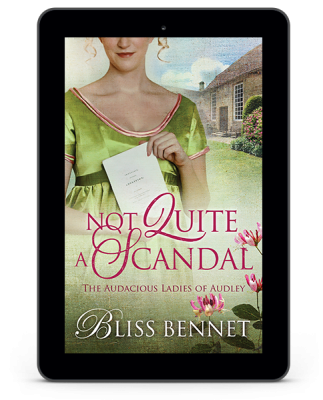
Title: Not Quite a Scandal
Series: Audacious Ladies of Audley, Book 2
Author: Bliss Bennet
Genre: Historical Regency Romance
An inheritance lost. A betrothal threatened. A scandal brewing…
Blurb: Outspoken Quaker Bathsheba Honeychurch knows how difficult it is for an unmarried woman to successfully champion political change. Her solution? Wed best friend Ash Griffin as soon as he comes of age and begin remaking the world. But when Ash’s urbane, aloof cousin arrives with inconceivable news, Sheba’s future dreams are suddenly at risk…
The death of the Earl of Silliman reveals an appalling lie: it is not Noel Griffin, but his long-lost cousin Ash, who is the true heir to their grandfather’s title. Raised to place family above all, Noel accepts his grandmother’s bitter charge: find Ash, disentangle him from his religious community, and train him to take on the responsibilities and privileges of a title that Noel had been raised to believe was his. Noel certainly won’t allow a presumptuous, irritating Quakeress to thwart him in doing his duty—no matter how fascinating he finds her…
When scandal threatens both their reputations, can Sheba and Noel look beyond past dreams and imagine a new world—together?

Before Sheba could offer an objection, Noel set himself in front of her. “Shall we try a simpler dance? A waltz, perhaps, M. de Brunhoff?”
A look of relief passed over the poor dancing master’s face. “As you wish, monsieur.”
The restlessness Noel had felt all afternoon, being in Sheba’s company but not the focus of her attention, settled as soon as he guided her hands up to rest against his shoulders. Unlike the more demure society misses with whom he typically danced, she kept her head held high, eyes not shying away from his. But the pink tint of her cheeks blazed nearly scarlet when he set his hands not on her elbows, as she was obviously expecting, but more daringly against her waist. That elusive scent of honeysuckle enticed his nose, and he could almost swear he felt the pulse of her blood coursing beneath his fingers, even with the weight of her silk gown and stays and his gloves between them.
“March, march, march, march, then messieurs, pirouette, mesdames, pas de bourée, pas de bourée, pas de bourée. Up, up, up on the toes, oui, oui…”
A satisfaction bone-deep settled over him at finally having Bathsheba Honeychurch in his arms. At being able to allow his eyes to roam without embarrassment or restraint over the sweep of her pert brows, the stretch of her lush mouth, the expanse of her graceful neck below that tip-tilted chin, confident and defiant in turn. He’d never had much sympathy for Goethe’s self-indulgent Werther, but the romantic hero’s assertion that “a maiden whom I loved, or for whom I felt the slightest attachment, never, never, never should waltz with any one else but with me” struck him as painfully apt.
He twirled her carefully, silently, unwilling to allow meaningless small-talk to distract him from a pleasure he feared he’d never stop craving.
She, too, remained quiet as the slow notes of the waltz enveloped them in a bubble of awareness, her blue eyes roving his face as his roved hers. She blinked, and blinked again, as if she could not quite understand what she was seeing.
Might she be beginning to recognize, even if she could not quite yet allow herself to believe, that the man standing opposite her might be more vital to her happiness than the one dancing on the other side of the room?
Yes, this was how he would win her. Not by wooing her with words, but by allowing her to see the truth of what he felt.
“Ah, yes, my lady, with what elegance you dance!” M de Brunhoff cried as Ash and Delphie twirled past him. “Now, let us vary the posture, eh? Messieurs, place your right arm fully about your partner’s waist, et mesdames, rest your hand and arm on your partner’s shoulder.”
Noel swallowed, then laced his arm behind Sheba’s waist. Although he kept her at a decorous distance, the heat of her warmed his entire side. And when her hand crept up his shoulder, her corseted breast mere inches from his chest, that warmth turned molten.
He felt, as well as heard, Sheba’s breath catch in her throat as his fingers tightened against her side.
The beat of the music, the tap of their slippers against the polished floor, the hum of pleasure he could not quite keep contained—Noel spun, and spun, dizzy with the turning, near giddy with longing.

****

Bliss Bennet writes smart, edgy novels for readers who love history as much as they love romance. Despite being born and bred in New England, Bliss has always been fascinated by the history of that country across the pond, particularly the politically-volatile period known as the English Regency. Though she’s visited Britain several times, Bliss continues to make her home in the States, along with her spouse and an ever-multiplying collection of historical reference books.
Bliss’s Regency-set historical romances have been praised as “savvy, sensual, and engrossing” by USA Today, “catnip for the Historical Romance reader” by Bookworlder, “romantic, funny, touching, and extremely well-researched” by All About Romance, and “everything you want in a great historical romance” by The Reading Wench. Bliss’s latest book is Not Quite a Scandal, the second book in The Audacious Ladies of Audley series.
Follow Bliss: Website | Facebook | X | Instagram | Bookbub | Amazon | Goodreads
****

Enter for a chance to win a $10.00 Amazon Gift Card.
a Rafflecopter giveaway
Follow the tour HERE for special content and a giveaway!

 Maggie Blackbird
Thanks for sharing my book with your readers, Maggie!
— Bliss B.
LikeLiked by 1 person
I think I would really enjoy these. Thanks so much!!
LikeLike